Launch everywhere at once
Startups announce launches, releases and hiring news on many channels at once: X, LinkedIn, their Discord community and the team Slack. Postuva schedules all of them from one post so they go live at the same minute, with each version formatted for its network.
A launch-day social media checklist
- Write the announcement once: what's new, who it's for, the link.
- Tailor it: a short X post, a fuller LinkedIn story, a community message for Discord or Telegram.
- Schedule everything for the same minute as the launch.
- Schedule a Slack message so the team can amplify it straight away.
- Queue follow-up posts for day 2 and day 7 with customer reactions and lessons.
Why do launches need coordinated timing?
Launch day attention is short. The first few hours decide whether an announcement trends, gets picked up or sinks. When the X post, the LinkedIn post, the community message and the team's Slack ping all go out within the same minute, early engagement stacks up: teammates share immediately, community members boost it, and each network sees momentum at once.
Coordinating that by hand, across time zones and with everyone busy on launch day, is fragile. Scheduling everything in advance, and checking the calendar the day before, makes the timing reliable.
Why one scheduler for public and community channels?
Your community expects to hear news first or at the same time as everyone else. Scheduling X, LinkedIn, Discord and Telegram together means nobody finds out from a stranger's repost.
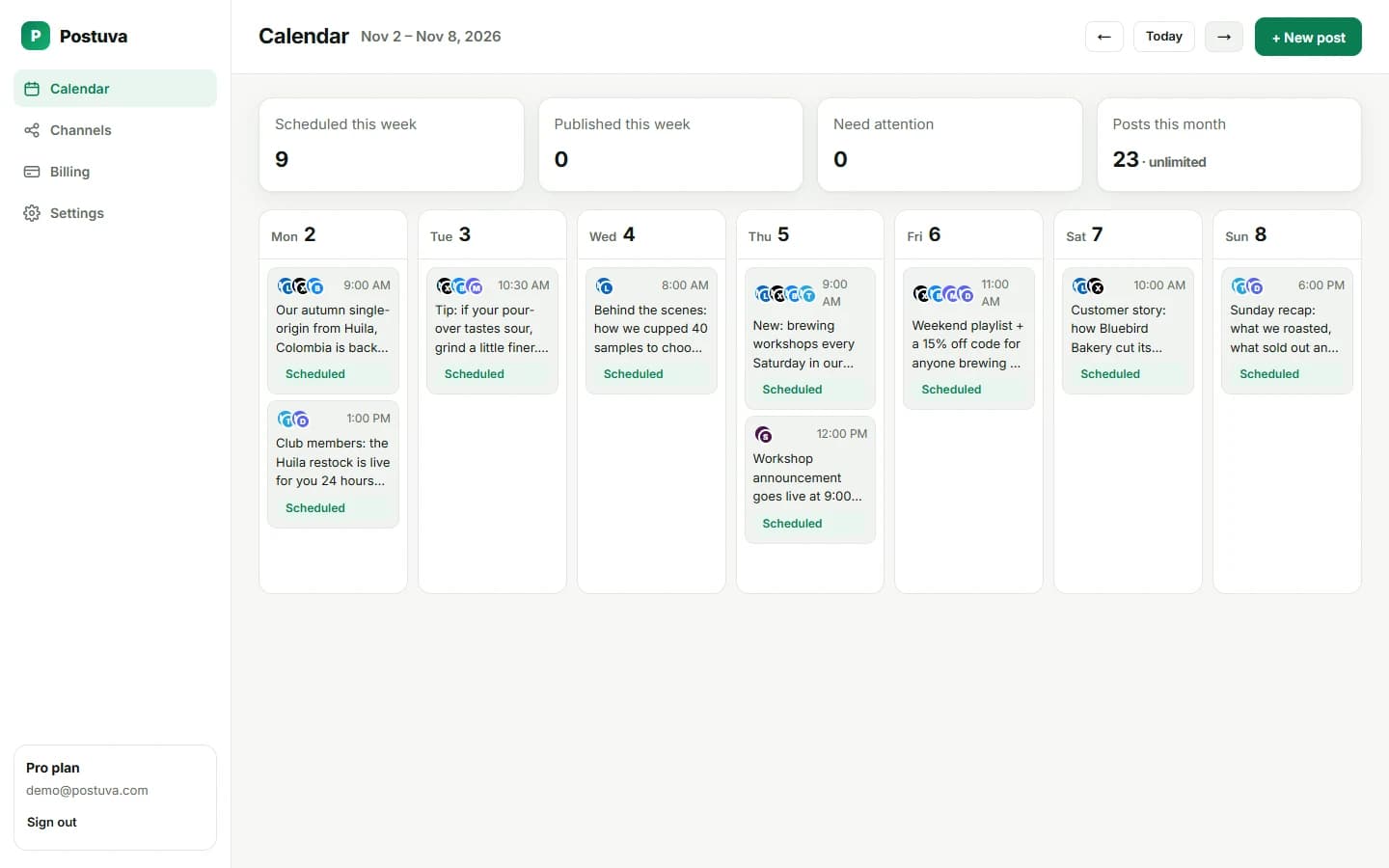
The launch-week calendar
| When | What | Where |
|---|---|---|
| 7 days before | Teaser: the problem you solve, a hint of what's coming | X, LinkedIn, community |
| 1 day before | Reminder with launch time; ask the team to be ready | Slack, community |
| Launch minute | The announcement with link and visuals | Every channel |
| Launch + 3 hours | Thank-you and first reactions | X, Bluesky |
| Launch + 2 days | Behind the scenes: how you built it | |
| Launch + 7 days | Results and lessons | LinkedIn, X |
Building in public without burning out
Sharing progress publicly attracts early users, investors and hires, but only if you keep it up. Schedule a weekly “what we shipped” post every Friday, written from your changelog. It takes ten minutes, keeps your audience warm between launches and gives your community channel a natural rhythm.
- Share real numbers when you can: signups, revenue, response times.
- Show the messy parts, such as bugs, pivots and lessons.
- Credit customers who helped shape the product.
- Keep one call to action per post.
Which networks matter for startups?
| Network | Best for | Typical content |
|---|---|---|
| X | Founders, developers, early adopters | Launches, build-in-public updates, opinions |
| B2B buyers, investors, hires | Customer stories, hiring, milestones | |
| Bluesky | Tech and developer communities | Updates, conversations |
| Discord | Your user community | Changelogs, feedback, support |
| Telegram | Communities, especially in crypto and international markets | Announcements |
| Slack | Your team and partner communities | Launch coordination |
Product Hunt and launch-platform tips
- Schedule your X and LinkedIn posts for the minute your launch-platform listing goes live.
- Post a Discord or Telegram message asking your community for honest feedback, not upvotes.
- Schedule a Slack message so the team can share and answer questions quickly.
- Plan a follow-up post for the next day with what you learned from launch feedback.
Hiring posts that work
Hiring announcements reach far more people when the team shares them, so schedule them like a launch: the company post on LinkedIn, a founder post on LinkedIn and X with a personal note about why the role matters, a message in your community Discord (your users are often your best candidates), and a Slack ping asking the team to reshare. Be specific about the problem the hire will solve, not just the job title.
Investor and milestone updates
Milestones such as a funding round, a revenue figure or a customer count work best as stories: what you set out to do, what changed, who helped. Write the long version for LinkedIn, a short one for X and Bluesky, and a thank-you for your community. Schedule them for a weekday morning in your main market so the first hours of engagement come from the people who matter most.
Which plan fits a startup?
Early-stage teams usually start on Creator ($15 a month) for the founder's own accounts and the company's X and LinkedIn. Once two or three people share the work, or you add a Discord community and a Telegram channel, Pro ($29 a month) gives you 30 channels, 5 teammates and 3 workspaces, for example one for the company, one for the founder's personal brand and one for an open-source project.
Frequently asked questions
Can I publish immediately instead of scheduling?
Yes, Publish now sends the post to every selected channel straight away.
Is there a free plan?
Yes, 3 channels and 30 posts a month.
Can teammates help schedule?
Yes. The Pro plan includes 5 team members and 3 workspaces.
What if a network rejects the launch post?
You see the exact reason on the post and can fix and retry in one click; other networks aren't affected.
How far ahead should we schedule launch posts?
Draft and schedule them at least two days ahead, then review the calendar the day before launch. Last-minute edits are fine because scheduled posts can be changed until they go live.
Should startups post from the company account or the founder's?
Both. Founder accounts usually reach more people on LinkedIn and X; the company account is the official record. Schedule the same news to both with different wording.
Can we schedule open-source release notes to Mastodon and Bluesky?
Yes. Both are supported, and developer communities on them often respond well to release notes.